Accommodation:
What the World Wants
Accommodation is the act of submitting one's life and external self to the expectations and influences of external authorities. This action suppresses the true or inner Self. With time the suppression becomes repression and the true Self may be lost or forgotten. The Shadow is built from the catacombs of lost fragments.
It is about the forgotten dreams, discouraged or forbidden. You don't want to go to college, be a chef, rock star, teacher, doctor; you're going to do something useful like computer science, accounting, the family business...You don't want to marry her, she's not right for you, she's too smart, not good enough, too old, too young... Often it is a mixture of both can'ts and shoulds: You can't win Olympic gold, so don't bother trying. You should be getting straight A's and join more clubs so you can attend Harvard. Accommodation is an attempt to avoid conflict and bring harmony.
When in Rome...
In the sense that a compromise is a combination of the qualities of different things, Accommodation is a compromise; it is a combination of the expectations and influences of external sources--parents, society, religion... But in the sense that a compromise is a settlement wherein each side makes concessions, it is not the same. Accommodation is about submitting to external pressure and expectations, a person sacrifices who they are and what they want for themselves so they can be who others want them to be; it is not a meeting of equals, rather the external authorities dismiss the view of the individual with little consideration. The individual is expected to adjust and make themselves suitable rather than the externals--society, family--also making adjustments.
So long as the compromise is not of Self, it remains an important facet for all of life, whereas In Accommodation, the first half of adulthood, a person is seeking to discover what the world wants of him; it has its place in childhood and early adulthood through social and ego-development, but must be shed at midlife for continued development. Compromise and negotiation replace Accommodation. The question for the second half of life is personal: What do I want of me? or What does my soul want of me? Refusal to address this question creates a midlife crisis which eventually forces it.
Who is that Masked Man?

A permanent life of Accommodation is for sheep, mindless creatures obediently following the leader, or more poetically it is the life of a swan lived as a duckling. But Accommodation is a necessary life phase, essential for of personal growth and ego-development. Humans are a species surviving in community; failure within community is a failure to survive.
Each person has multiple personae, interchangeable masks or roles that one assumes to fit various situations. The persona allows for conformity within an environment, but is also interchangeable for the different roles of daily life. The different personae are recognizable facets of a single individual.
There is with the use of personae, a process of becoming. Wearing various masks allows for learning about life roles through practical experience. The chosen roles are usually a blend of familial and socio-cultural expectations and influences, the desired or fantasy Self and the true Self. To wear a mask is to take on the characteristics of the qualities represented by the mask; it is also a method for recognizing that the characteristics are present within one's Self.
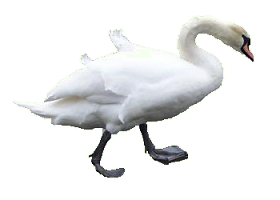
The use of masks in traditional and ceremonial rites throughout the world is universal, having been familiar to most cultures at some point in history. Representing roles both magical and practical, masks were often embedded with deep spiritual and religious significance, for some they were the portal to the divine--allowing for communication or, in some cultures, union with the gods or spiritual entities. There is a safety behind the mask and a fascination in experiencing new roles which can serve as a connection to new ideas and expanding relationships with Self, the divine and within the community. The danger with Accommodation is that it can lead to identification with the role--thinking that the mask is the person and thus failing to recognize and come to know the true Self. In midlife there is a pull from the foreign though internal force along with the discovery that one is a swan. It is a creature renowned for its grace and beauty, perhaps by those who observed it only in flight or on water, for it is a clumsy swaying creature upon the land. Like the swan, a person in midlife must find his place of belonging--his place of natural grace.
In Accommodation a person places their center outside of themselves, living life through others. Midlife is a tug-of-war as their true center pulls for inner balance. For MLCers there is a backswing after years of Accommodating and the process of self-centering involves first becoming selfish. In crisis, they are like a top spinning off balance in a clumsy wobble; the midlife journey brings a persons Self and inner balance into alignment.
A person's discovery that the mask he's worn for everyone, including himself, was just that--a mask--initiates the midlife transition. Self-questioning is a midlife issue wherein Accommodation as a way of life is questioned. Is this who I really am? Is this who I want to be? Was this ever who I wanted to be--or is this who someone else wanted or told me to be? Who am I? Who do I want to be?
The more Accommodation is a life in opposition to a person's true Self, the farther he is from his center and thus the more difficulty he will have transitioning at midlife. The person who resists the influence or pressure to conform, or for whom such pressures are in alignment with his true Self, will have a smoother midlife transition. The greatest disparities between true Self and the persona are more likely to result in a transition of crisis levels. These are also the most likely to encounter resistance to their midlife changes from the external sources to whom they submitted in Accommodation.
Do you feel like a deer about two seconds after seeing the headlights?

You know you’ve gotta stop crying, panicking or asking your spouse ANYTHING. And you know you should let-go and give space so that you can learn to respond and communicate with your spouse from a place of calm rather than emotional hurt.
Introducing
Understanding Midlife Crisis
The foundational course to give you answers and clarity into "What the he!! Is going on with my spouse!"